
Our Safety Program
OSHA-compliant work practices — protecting our crew, your property, and your liability exposure.
Why safety runs the job
The reason we take safety seriously isn’t compliance paperwork — it’s simpler than that. Our crew comes home at the end of every shift. Your property doesn’t become a claim. Our insurance costs stay manageable, which keeps our pricing competitive. Every OSHA standard we follow exists because someone, somewhere, got hurt when it wasn’t followed. We don’t run that experiment on our people or on your job site.
OSHA Compliance
29 CFR 1926 Subpart M — Fall Protection (29 CFR 1926.501)
The duty to have fall protection at heights above six feet on construction sites is established in 29 CFR 1926.501. All Black Canyon crew on siding, gutter, and window work above six feet are anchored to a personal fall arrest system (PFAS) — full-body harness, shock-absorbing lanyard, and a certified anchor point rated to withstand a 5,000-pound load per anchor per worker, or designed and installed by a qualified person under a lower-limit system.
Harnesses are inspected before every shift by the crew lead and formally inspected annually by a competent person. Any harness that has arrested a fall is immediately removed from service and replaced — no exceptions. We do not use guardrail systems on residential sloped roofs; PFAS is the standard. On commercial flat roofs, we use a combination of guardrails, PFAS, and safety monitoring systems depending on scope and roof geometry.
29 CFR 1926.1153 — Respirable Crystalline Silica
Concrete bollard installation and concrete saw-cutting generate respirable crystalline silica dust, which is regulated under 29 CFR 1926.1153. Our exposure control plan for paving and bollard crews uses wet-cutting methods as the primary control: water suppression applied at the blade during all concrete cutting operations. Where wet-cutting is not feasible, we use handheld grinders and cut-off saws equipped with HEPA-filtered integrated vacuum systems rated to capture at least 99.97% of particulate at 0.3 microns.
Workers in silica-exposure tasks are provided N95 minimum respiratory protection as a supplemental layer when engineering controls alone cannot keep exposures below the action level (25 µg/m³ as an 8-hour TWA). Paving crew leads conduct quarterly silica exposure assessments and maintain written records per the standard.
29 CFR 1926.95 & 29 CFR 1926.100 — Personal Protective Equipment
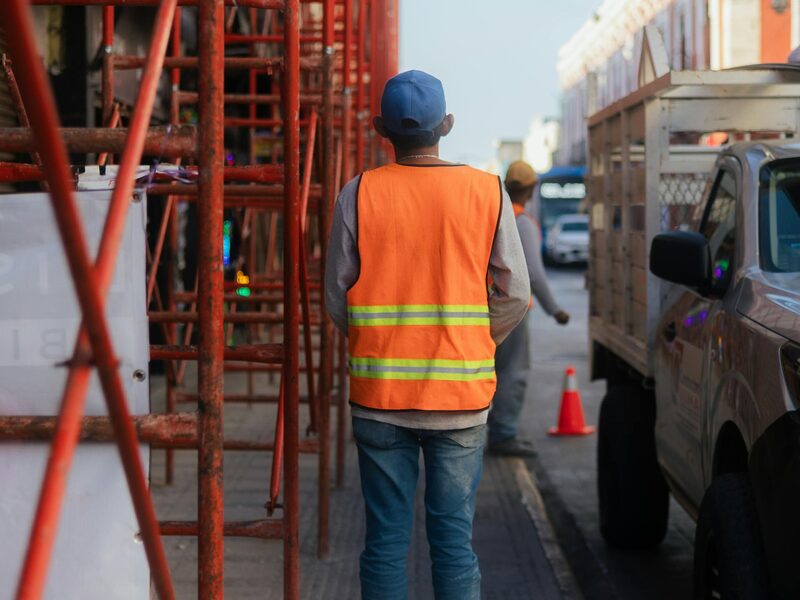
Hard hats (ANSI/ISEA Z89.1 Type I or II, Class E) are required on all Black Canyon job sites. Safety glasses meeting ANSI Z87.1 are worn during any task generating flying debris, dust, or chemical exposure. Class 2 high-visibility vests are required on all roadway, parking-lot, and any work within 15 feet of vehicle traffic. Steel-toe boots meeting ASTM F2413 are required for all crew.
29 CFR 1910.1200 — Hazard Communication (HazCom / GHS)
Every Black Canyon truck carries a Safety Data Sheet (SDS) binder for every chemical product in use on that crew’s work scope. Containers are labeled per GHS requirements — no unlabeled secondary containers on job sites. All crew complete annual HazCom training covering GHS label reading, SDS interpretation, and proper handling of the specific products used in their trade (sealers, adhesives, traffic paint, solvent-based caulks). Training records are maintained at the office.
OSHA Certification Levels
All Black Canyon Exteriors crew members hold a minimum of an OSHA 10-Hour Construction card before their first day on a job site. Crew leads and supervisors hold the OSHA 30-Hour Construction certification.
Our field supervisor holds the Supervisor Fall Protection Competent Person designation, as required for any worksite using personal fall arrest systems under 1926 Subpart M. The Competent Person designation means they are capable of identifying existing and predictable fall hazards and has the authority to take prompt corrective measures to eliminate them.
Paving and bollard crews include at least one designated Silica Competent Person per crew — trained to assess silica exposure conditions, implement controls, and evaluate the effectiveness of those controls per 29 CFR 1926.1153.
Daily Safety Practices
Every working day starts with a tailgate safety meeting: a five-minute pre-shift briefing on that day’s specific hazards. The hazards are not generic — they reflect the actual tasks scheduled (elevated siding work vs. ground-level gutter cleaning vs. seal coat application), the site conditions (occupied building, high-pedestrian area, adjacent traffic), and any environmental factors (wind, rain, temperature extremes).
Each tailgate meeting is documented on a Job Hazard Analysis (JHA) / Job Safety Analysis (JSA) form that lists the day’s tasks, the associated hazards, and the controls in place. Every crew member signs the form before work begins. These forms are retained at the office and are available to property owners or managers on request for active projects.
For any non-routine task — an unexpected structural condition, an unusual anchor point requirement, working adjacent to an energized overhead line — work stops and a pre-task JHA is completed before that specific task begins. Equipment inspection logs are completed daily. The crew lead conducts a site walk before mobilization at each new job to identify overhead powerlines, uneven ground, occupied buildings, and adjacent pedestrian routes that require traffic control or barrier placement.
Traffic Control & MUTCD
Parking-lot striping, asphalt repair, and curbside paving work comply with the Manual on Uniform Traffic Control Devices (MUTCD), Part 6, which governs temporary traffic control for highway and street work zones. For roadway work, we use an ATSSA-certified flagger. Cone tapers, advance warning signs, and channelizers are sized to the posted speed limit of the adjacent roadway per MUTCD Figure 6H prescriptive setback tables. We do not improvise traffic control layouts on a job-by-job basis — the plan is determined before mobilization and documented.
Incident History
Our Experience Modification Rate (EMR) and OSHA recordable incident history are available for review as part of commercial prequalification. We do not publish a specific EMR here because it is a point-in-time figure that changes with each policy renewal — current figures are provided directly during the vendor qualification process and in our prequalification packet.

Your site, your rules
When working on commercial property with a site-specific safety plan, we follow your plan in addition to our own. Lockout/tagout (LOTO) coordination for work near energized equipment, contractor orientation and badging requirements, escalation contacts for incidents, and check-in/check-out protocols are all respected and documented before work begins. If you have a safety director or facilities manager who wants a pre-job meeting with our crew lead, that’s a standard part of our commercial onboarding for new sites — not an exception.
Questions about our safety program? Ask.
We can provide our safety manual, JHA forms, or OSHA certifications on request.