

Concrete Bollard Compliance — ADA, OSHA, and Municipal Requirements for Utah
Bollard placement that blocks accessible routes, obstructs fire lanes, or violates OSHA material storage requirements creates liability independent of the vehicle protection they provide. Here is the compliance framework.
ADA Accessibility Clearance Requirements
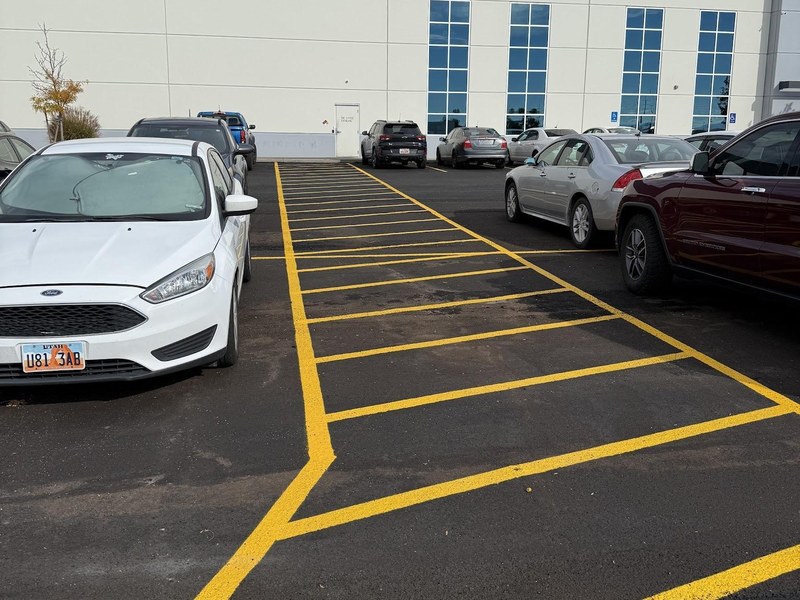
ADA 2010 Standards Section 307 (Protruding Objects) requires that bollards placed in pedestrian circulation paths maintain a minimum 36-inch clear width. The preferred clearance is 60 inches to allow two wheelchair users to pass simultaneously. Bollards at the ends of accessible parking stall access aisles must not reduce the aisle width below the ADA minimum: 5 feet for standard accessible stalls and 8 feet for van-accessible stalls. Bollards that protrude into a pedestrian path with their leading edge between 27 and 80 inches above grade create a cane-user hazard—they are detectable above 80 inches and below 27 inches, but the 27-to-80-inch range is the "blind zone" for cane travel. Standard 36- to 42-inch bollards fall within this blind zone. Placement must ensure bollards are either within a circulation path where detection is expected, or positioned outside the circulation path entirely. We design bollard layouts with ADA accessible route compliance as a primary constraint, not an afterthought.
OSHA Material Storage and Forklift Traffic Protection
OSHA 29 CFR 1910.176(e) requires that where mechanical handling equipment is used (forklifts, pallet jacks, hand trucks), sufficient safe clearances must be allowed for aisles, at loading docks, through doorways, and wherever turns or passage must be made. OSHA does not mandate bollards specifically, but they are the industry-recognized method for protecting columns, utilities, and pedestrian zones from forklift strikes. OSHA 29 CFR 1910.178(e) requires that industrial trucks (forklifts) be operated safely, and that equipment and structures are maintained to protect employees. Bollard protection of warehouse rack columns, electrical panels, fire suppression risers, and pedestrian walkway boundaries is considered best practice and will be evaluated favorably in OSHA compliance audits following an incident. We size bollards for the vehicle class present: standard 6-inch Schedule 40 for passenger vehicle and hand-pallet jack environments; 8-inch Schedule 40 for forklift and delivery truck zones.
Municipal Permit and Building Code Requirements
Permanent embedded bollards installed in or adjacent to public rights-of-way (sidewalk bollards, storefront bollards near the property line) typically require a building permit in Utah municipalities. Salt Lake City, West Jordan, Sandy, Provo, and Orem all require permits for permanent concrete penetrations in paved surfaces. Permit requirements for bollards installed entirely within private property vary by municipality. Our experience is that most Utah municipalities require a permit for embedded bollards; surface-mount bollards generally do not trigger a permit requirement. We submit 811 utility locate requests as a prerequisite for any concrete penetration. Some municipalities require an inspection after installation before backfilling the core annulus—we coordinate inspection scheduling with local building departments.
Fire Lane and Fire Marshal Requirements
Bollards installed at fire lane entries must maintain the minimum fire lane width specified by local fire codes and NFPA 1: typically 20 feet clear width for a straight run, 26 feet for curves. Bollards used to define fire lane boundaries or restrict unauthorized parking within fire lanes must be configured to allow fire apparatus access—removable bollard systems with a fire department key override are often required by fire marshals at lane entries. We coordinate fire lane bollard layouts with local fire marshal requirements before installation. Any bollard configuration that reduces fire apparatus access without fire marshal sign-off is a code violation.
Recent Concrete Bollards Projects

Common Questions
- Do bollards require a licensed contractor in Utah?
- Utah requires contractor licensure for work above certain dollar thresholds. Concrete boring and structural steel placement in commercial settings is licensed work—we hold a current Utah contractor's license. Verify contractor licensing through the Utah Division of Occupational and Professional Licensing (DOPL) database before hiring any contractor for bollard installation.
- What documentation should I keep after bollard installation for compliance purposes?
- Retain the contractor's written completion report (we provide this), permit sign-off from the municipality when applicable, 811 utility locate confirmation, and any post-strike inspection reports. These documents support your defense in a premises liability claim and demonstrate due diligence in OSHA compliance audits.
- Are there anti-terrorism standards we should consider for our facility?
- For facilities with elevated threat profiles—federal buildings, high-profile retail, infrastructure protection—consider bollards tested to ASTM F2656 (vehicle crash test for roadway security barriers) or IWA 14-1 (international vehicle impact standard). Standard commercial embedded bollards are not rated for hostile vehicle mitigation. We can help you specify and source rated products for high-security applications.
Ready to Get Started?
Get a free, itemized estimate for your commercial concrete bollards project. We typically schedule site visits within 48 hours and deliver written quotes the next business day.
Get In Touch
Ready for a quote or have a question? We’re Utah-based, Utah-run, and we’ll come out to your property for a free on-site estimate.
Get A Free Quote