
Seal Coat Process — From Crack Seal to Final Cure
A seal coat application is only as good as the preparation. Here is the process that produces a seal coat that adheres uniformly and lasts through a full Utah maintenance cycle.
Step 1 — Crack Seal Prerequisite (48 Hours Prior)
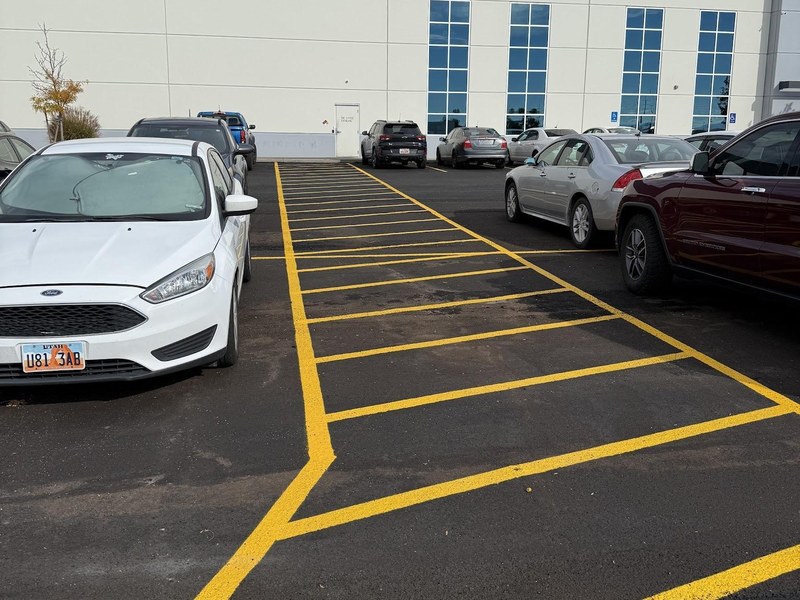
Seal coat is not a crack filler. Any crack over 1/4 inch wide on the lot must be crack-sealed before seal coat is applied. We apply hot-pour rubberized sealant to all qualifying cracks 48 hours before the seal coat crew arrives—the full cure period allows the sealant bead to bond to the crack walls and harden so the squeegee or spray application passes over it cleanly without pulling the bead out. Applying seal coat over fresh (uncured) crack sealant transfers the emulsion onto the sealant surface and contaminates the bond surface of both materials. The 48-hour minimum between crack seal and seal coat is non-negotiable.
Step 2 — Surface Preparation
The day before or morning of application, the lot is swept or blown clean with a commercial power broom or blower. Leaf litter, sand, small gravel, and loose material must be removed—emulsion applied over debris is a bond failure point. Oil spots from vehicle drips are treated with an asphalt primer specifically formulated to encapsulate petroleum contamination. Standard asphalt emulsion sealer does not bond to petroleum-contaminated asphalt—oil spots left untreated will peel within one season. We identify and prime all oil spots during the preparation pass. Primer cure: 1 to 2 hours before sealer application. If the lot has been recently power-washed (a practice some property managers use for oil removal), allow 24 hours of drying before applying sealer.
Step 3 — Edging and Masking
Edges adjacent to building faces, curbs, and concrete transitions are applied by hand with a brush or roller before the squeegee or spray pass begins. Hand edging ensures coverage at boundaries where the squeegee or spray pattern cannot reach without overspray. Expansion joints between asphalt and concrete (at building aprons, sidewalk edges) are masked with tape to prevent sealer from bridging the joint—sealer over an expansion joint cracks immediately at the joint line and peels the adjacent coating edge. Masking tape is removed while sealer is still in its tack phase (not fully dry) to prevent the tape from bonding permanently to the surface.
Step 4 — Squeegee or Spray Application, Sand, and Cure
Squeegee application: sealer is poured or pumped in front of a steel squeegee pulled by a commercial sealer machine. Squeegee produces even film build on rough or textured surfaces and allows better control on lots with complex geometry (curb islands, grade changes). Spray application: an airless pump sprays a fan pattern over smooth, open lot sections—faster production rate but requires more skill to achieve even film build and avoid overspray. We use squeegee as default on commercial lots; spray for high-production requirements on smooth, open surfaces. First coat applied, dried to tack-free state (2 to 4 hours), then second coat applied. After second coat achieves tack-free state, sand broadcast is applied if additional traction is required (included in standard scope). Cure for vehicle traffic: 24 hours minimum. Property is closed to vehicles during this period via cones and signage.
Recent Seal Coat Maintenance Projects
Common Questions
- How do you handle a lot with heavy traffic that cannot close for 24 hours?
- We phase seal coat in sections—typically two or three sections over two to three days—so access to the property is maintained throughout. Each section is closed for its 24-hour cure while the other sections remain open. Section boundaries are planned with you in advance to minimize operational disruption and maintain ADA access throughout the project.
- Can seal coat be applied over a lot with oil stains we did not disclose?
- We identify oil stains during the preparation pass and prime all spots we find. However, if you know of specific areas with heavy oil contamination (a former drive-through, a mechanical work area), flag them during the site walk. Heavily contaminated areas may require pressure washing and extended dry time before priming—this affects scheduling.
- What happens if it rains within 24 hours of application?
- Rain within 4 hours of application will wash the emulsion before it sets—this requires re-application of the affected section. Rain after 4 hours but before 24 hours may cause surface dimpling or slight discoloration but typically does not require re-application if the surface has achieved tack-free state. We monitor forecasts 48 hours ahead and will not begin a seal coat project if rain is forecast within the cure window.
Ready to Get Started?
Get a free, itemized estimate for your commercial seal coat maintenance project. We typically schedule site visits within 48 hours and deliver written quotes the next business day.
Get In Touch
Ready for a quote or have a question? We’re Utah-based, Utah-run, and we’ll come out to your property for a free on-site estimate.
Get A Free Quote