
Parking Lot Striping Specifications — Paint, Thermoplastic, Glass Beads, and ADA Standards
The specification you choose—paint versus thermoplastic, bead rate, application temperature—determines whether your markings last one year or seven. Here is the technical detail.
Traffic Paint Specification
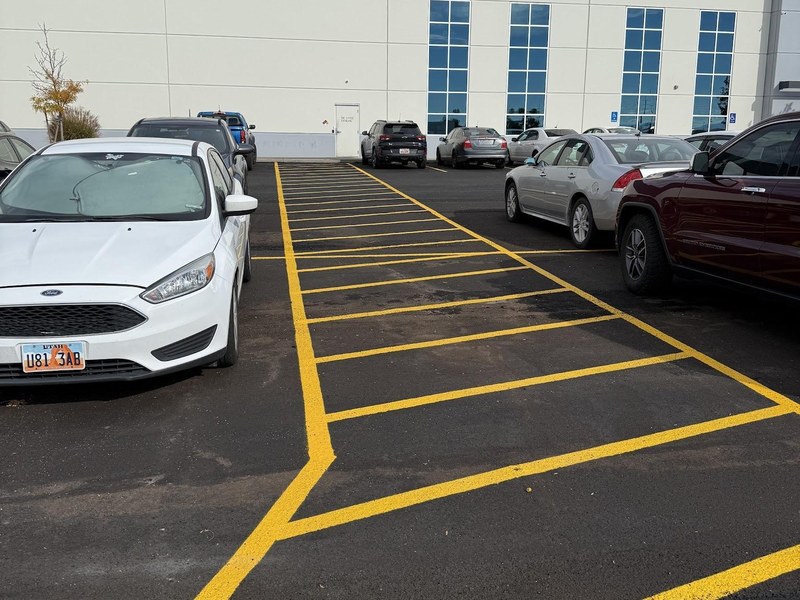
Waterborne traffic paint applied by airless spray at 7 to 10 wet mil DFT (dry film thickness). Minimum dry film thickness: 5 mils per MUTCD retroreflectivity requirements for night visibility. Paint specification: waterborne alkyd-acrylic or 100 percent acrylic traffic marking paint meeting APWA Class B standards for marking durability. White paint: Federal color 37925; yellow: Federal color 33538; red: Federal color 31136 (fire lane and curb markings). Application temperature: 50°F minimum ambient, pavement surface dry, no precipitation within 2 hours of application. Glass beads: Type 1 AASHTO M247 glass beads applied at 6 to 8 pounds per 100 square feet immediately after paint strike to provide retroreflectivity. Retroreflectivity of fresh waterborne paint with beads: approximately 300 to 400 mcd/lux/m2—exceeding MUTCD minimum of 150 mcd/lux/m2 for new installation.
Thermoplastic Marking Specification
Alkyd thermoplastic applied by extrusion at 400 to 430°F to a minimum 90 mil DFT (0.09 inch) per AASHTO M249 specification. Thermoplastic is a heat-fused material that bonds to the pavement surface on cooling—it does not rely on adhesive or solvent bond. Glass beads are incorporated into the thermoplastic compound at 3 percent by weight (pre-mix beads) and additionally broadcast at 6 to 8 pounds per 100 sq ft (drop-on beads) for immediate retroreflectivity. Retroreflectivity of fresh thermoplastic: 400 to 600 mcd/lux/m2. Application temperature: pavement surface must be 50°F minimum, dry, and clean. Thermoplastic cannot be applied over fresh traffic paint, oil contamination, or wet surfaces. Service life: 5 to 7 years in commercial parking lot applications with moderate traffic.
ADA Symbol and Accessible Stall Specifications
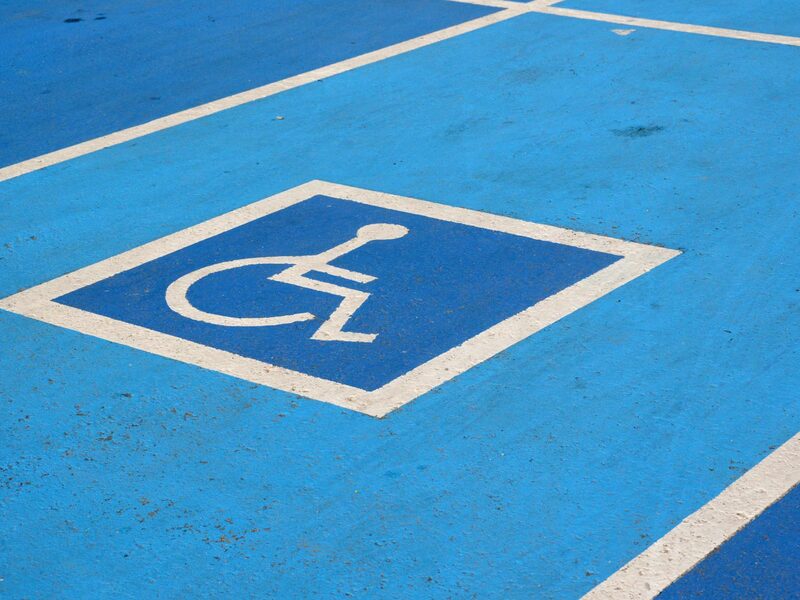
International Symbol of Accessibility (ISA): white symbol on blue field per ADA 2010 Standards. Symbol size: minimum 36 inches in height per ADA; we install at 44 inches for improved visibility. Blue field size matches symbol proportions. ADA accessible stall dimensions: 8 feet wide minimum plus 5-foot access aisle for standard accessible; 8 feet wide minimum plus 8-foot access aisle for van-accessible (or 11-foot-wide stall with 5-foot aisle). Access aisle must be marked with "NO PARKING" lettering in 12-inch white paint minimum height. Accessible stall border lines: 4-inch white double lines. ADA symbol material: thermoplastic for commercial lots—painted symbols fade below recognizable levels in 12 to 18 months. Sign requirements: mounted 60 to 66 inches to sign bottom on a post or building-mounted bracket.
MUTCD Parking Lot Dimension Standards
Standard stall lines: 4-inch white lines, 18 feet long for 90-degree stalls, 19 feet for 45-degree angled stalls (to maintain consistent front-of-stall alignment). Stall width: 8.5 to 9.0 feet standard, 8.0 feet compact (if jurisdiction allows). Drive aisle width: 24 feet minimum for 2-way traffic with 90-degree stalls; 15 feet minimum for 1-way traffic. Stop bars: 12 to 24 inches wide white line at aisle intersections and pedestrian crossings. Directional arrows: per MUTCD Figure 3B-17, 12 to 18 feet long in drive aisles with restricted visibility. Fire lane stencil: "FIRE LANE NO PARKING" in 4-inch letters minimum height at 50-foot intervals along the fire lane length. Fire lane curb paint: standard red curb, 6 to 8 inches down the curb face.
Recent Striping Projects
Common Questions
- What is the minimum acceptable retroreflectivity for existing parking lot markings?
- MUTCD Section 3A.03 establishes minimum retroreflectivity levels for maintained markings. For longitudinal lines (stall lines, fire lanes): 100 mcd/lux/m2 minimum for white, 75 mcd/lux/m2 minimum for yellow. Markings below these minimums should be re-applied. We can perform retroreflectivity measurements on existing markings during our site assessment using a calibrated retroreflectometer.
- Should ADA symbols always be thermoplastic?
- For commercial lots, yes. Painted ISA symbols fade below recognizable levels within 1 to 2 years in Utah's UV-intense climate. ADA enforcement inspections focus on accessible stall markings specifically—faded symbols are a citation risk. Thermoplastic ISA symbols last 5 to 7 years and are the correct specification for any commercial property that cannot re-stripe annually.
- Is there a standard for stop bar width?
- MUTCD recommends stop bars of 12 to 24 inches wide. We apply 18-inch stop bars at drive aisle intersections as a default—wide enough to be clearly visible from an approaching vehicle at normal lot speeds. At pedestrian crossings, we use 24-inch stop bars to increase driver awareness.
Ready to Get Started?
Get a free, itemized estimate for your commercial striping project. We typically schedule site visits within 48 hours and deliver written quotes the next business day.
Get In Touch
Ready for a quote or have a question? We’re Utah-based, Utah-run, and we’ll come out to your property for a free on-site estimate.
Get A Free Quote